From paper to payment: How AI is automating Uber Freight’s core payment and auditing operations
The logistics industry thrives on movement, but its financial engine often stalls on paperwork. For years, the process of Freight Audit and Pay (FAP)—verifying carrier Proof of Delivery (PODs) to trigger payment—has been manual, time-consuming, and prone to error.
At Uber Freight, this was a critical bottleneck. Reviewing hundreds of thousands of complex documents monthly created a manual grind that tethered our experts to paperwork and extended invoice remediation cycles. This was a clear friction point, slowing our internal efficiency and limiting the speed and reliability of carrier and customer service.
Our mandate is clear: We earn the right to use AI by first driving operational excellence through rigor and standardization. We use AI to solve the routine and remove the manual grind within our own walls, enabling our teams to move faster and smarter for our customers. DocAI—which automates the journey from a messy, hands-on PDF process to a touchless verified payment—builds on this 'inside-out' strategy.
The pivot to "touchless payment"
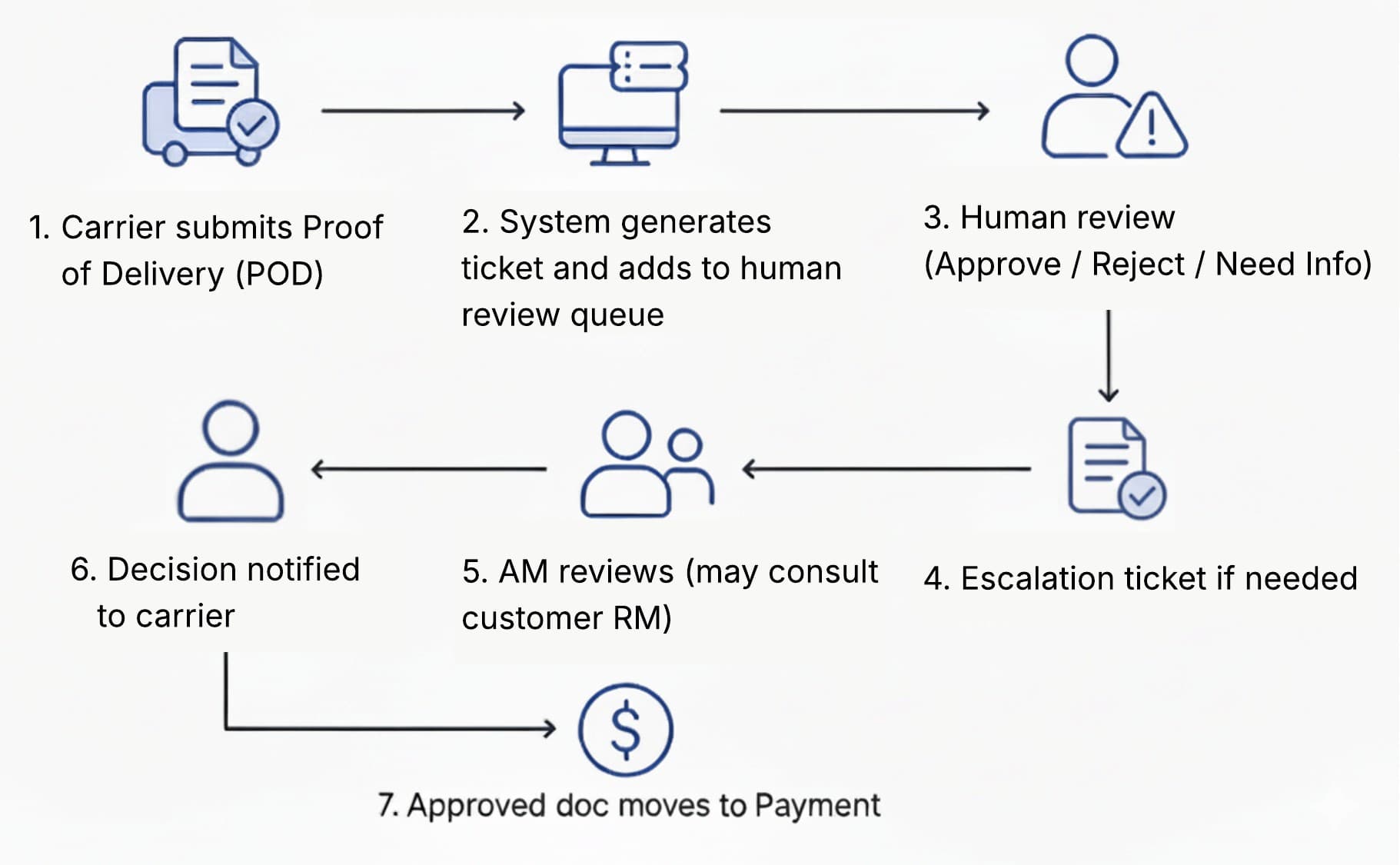
Our previous workflow required human review for nearly every document involved in the payment process, from POD to lumper fees, detention, and more. This created a manual burden that tethered our experts to paperwork, keeping them from the high-stakes strategy and complex problem-solving most valuable to customers. Our vision was to flip this model: transform the default status of a load from "manual review required" to "auto-approve."
This concept—the "Touchless Payment"—is achieved when a document is uploaded and verified automatically, triggering payment without human intervention. This shifts 2,500 hours of expert logisticians’ time from document checking to problem-solving, focusing their time only on complex or escalated issues.
The technology: vision meets validation
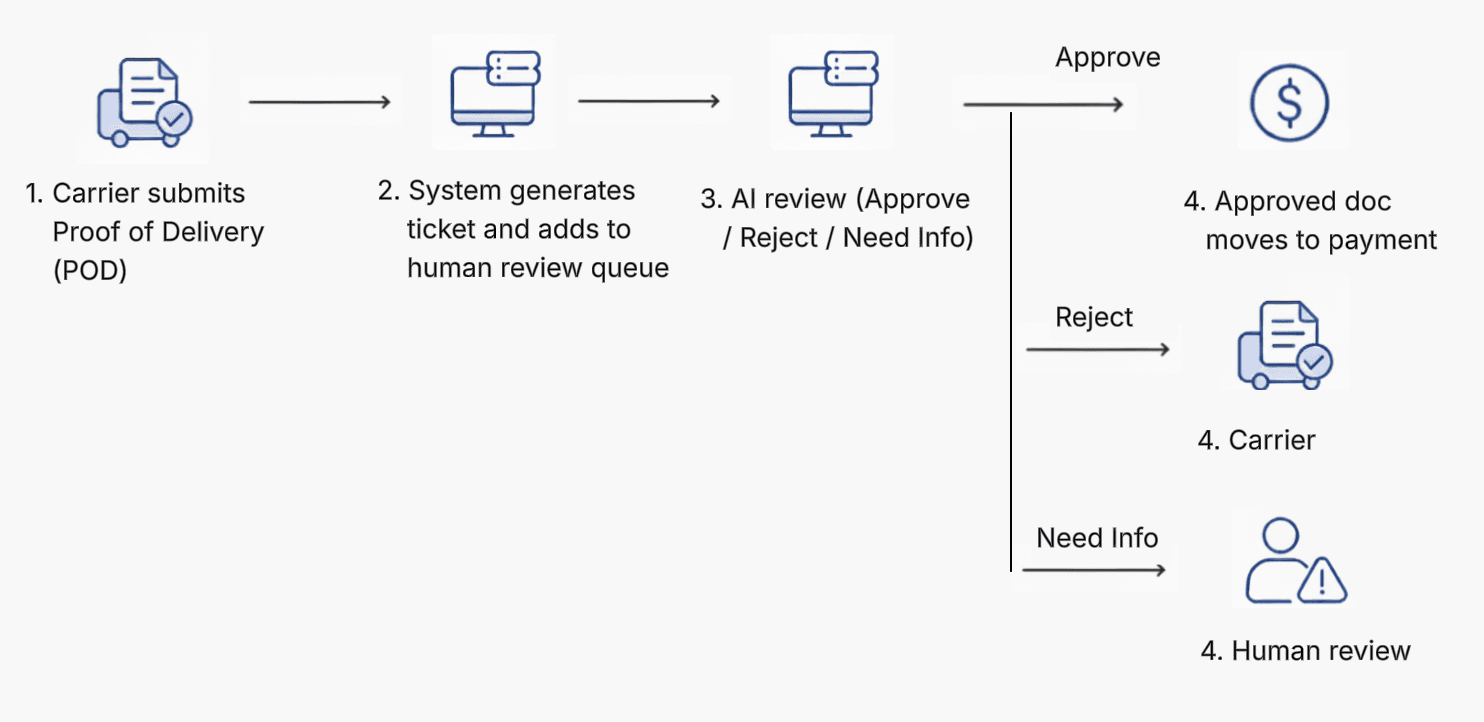
Most logistics technology only uses computer vision to scan and digitize documents. DocAI moves beyond this and handles the full document-to-payment cycle, autonomously matching paperwork to system data and authorizing payments.
Instead of relying on a single model, our platform orchestrates a “council of LLMs” (including powerful models like Gemini and GPT). This ensemble approach allows us to:
See and classify: Accurately identify the document (is it a valid POD or something else?).
Extract: Pull key data points, such as PO numbers, delivery dates, and addresses.
Validate against truth: Compare the extracted data against the guaranteed shipment data in our system.
Confirm compliance: Crucially, the system can verify complex, subjective requirements, such as the presence and validity of a customer-specific stamp or signature—a check that previously required extensive BPO team training and massive rule books.
Impact: efficiency as a competitive advantage
The implementation of DocAI is already delivering significant, measurable operational gains that redefine how efficiently we can run our business:
Benefit | Key result | Why it matters | |
Carrier liquidity (Velocity) | Instant payment qualification | Better capacity access | |
Billing precision (Accuracy) | 50% reduction in disputes | Frictionless financials | |
Audit certainty (Compliance) | 100% document audit | Compliance confidence | |
Data integrity (Insight) | >99% extraction accuracy | Cleaner supply chain data |
This is more than just a cost-saving measure; it is a fundamental transformation of our core payment and audit engine. By streamlining this critical internal operation, we are better positioned than ever to deliver unparalleled value and service to our customers, making Uber Freight a truly AI-first logistics partner.
Future horizons: We plan to expand this automation to other document types, including lumper receipts and invoices, pushing us closer to a fully touchless, real-time logistics operation.