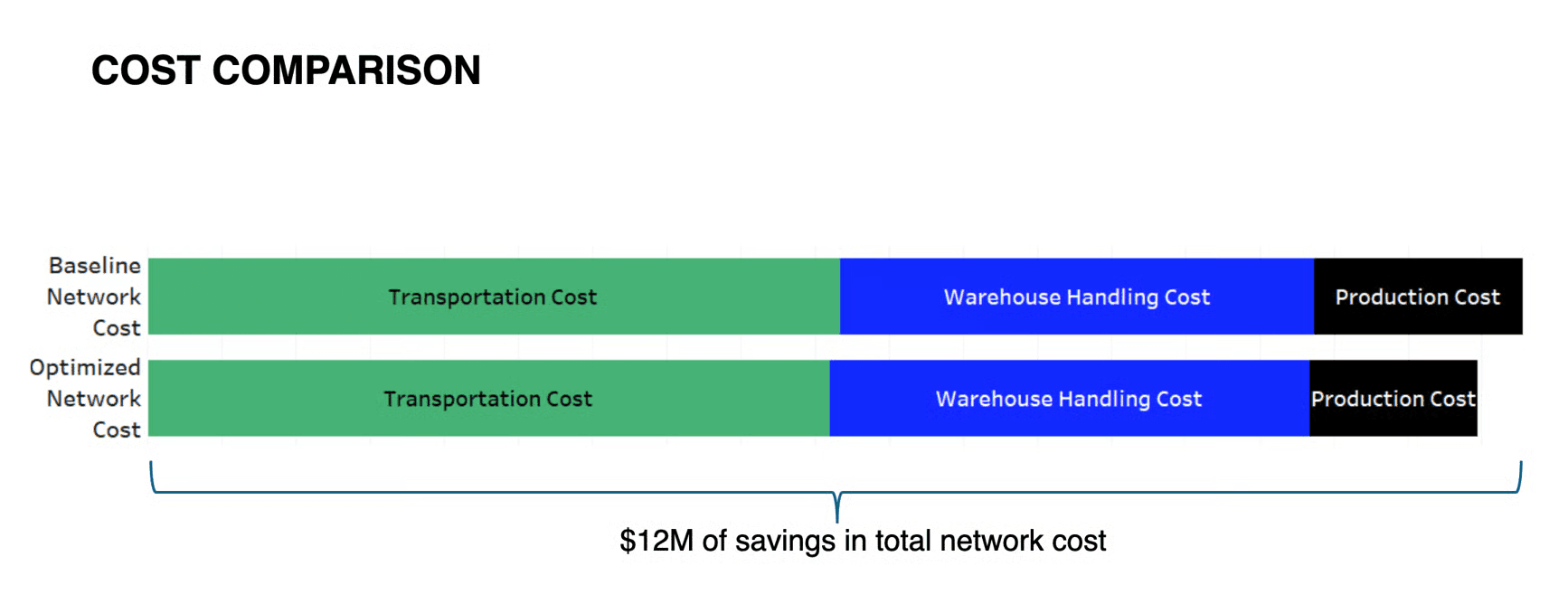
Transforming network design with digital twins: Achieving $12M savings for a leading snacks manufacturer
Opportunity
In 2024, a leading North American snacks manufacturer faced a pivotal challenge: how to accurately assign customer demand to distribution centers (DCs) and reallocate production among multiple plants in order to achieve the lowest total landed cost. The company sought a future-focused, comprehensive approach to guide distribution center space planning and utilization for 2025 through 2030.
Uber Freight had previously developed separate models for production optimization and network distribution for the manufacturer.
However, operating these models independently risked overlooking significant synergies and cost-saving opportunities. Recognizing the need for a holistic solution, the manufacturer engaged Uber Freight to develop an integrated network optimization model, ensuring strategic and data-driven decision-making across a complex footprint of internal plants, regional DCs, external manufacturers, and co-packers. Each co-packing facility imposed unique restrictions tied to production lines, operating hours, and product group capabilities.
Solution
A roadmap to drive efficiency and control
To address the challenge, Uber Freight deployed advanced digital twin technology, constructing a robust multi-year growth model tailored to the manufacturer’s intricate network and long-term business objectives.
Uber Freight worked closely with the manufacturer to gather, cleanse, and validate vital supply chain data, ensuring a deep understanding of the production landscape, sourcing strategies, and service level requirements for all facilities. Special attention was given to the specific operational parameters of each co-packing site.
With these insights, the team developed a comprehensive model capturing both production and distribution dynamics. This enabled accurate reallocation of production and assignment of demand to optimal DCs, optimizing transportation and manufacturing flows within the company’s existing network. To ensure ongoing agility,
Uber Freight created digital twin scenarios projecting demand and capacity through 2030. These sophisticated growth simulations enabled the manufacturer to precisely calculate future DC capacities and adapt operations accordingly.
Results
Significant improvements in inventory management
Uber Freight’s integrated, forward-thinking approach yielded measurable impact:
39%
improvement in backlog units
15%
improvement in shipping
63%
improvement in warehouse inventory accuracy
By fusing production and distribution analytics into a single, dynamic optimization model, Uber Freight provided the foundation for resilient, cost-effective supply chain strategies. The manufacturer can now plan with confidence, assured that its network is optimized for both current operations and future growth.