Logistics AI | Technology release notes
Uber Freight technology release notes
In the next era of supply chain, your competitive edge will come down to the strength of your AI capabilities—and the quality of the data that powers them. At Uber Freight, we’ve spent the last 20 years building what others can’t replicate: one of the largest and most diverse logistics datasets in the industry. It’s this depth and the cleanliness of our data that sets our AI apart. Smarter. Operational. Engineered to execute. Built for logistics.
In this issue of our technology release notes, we’re sharing how Uber Freight is applying generative, agentic, and physical AI across the logistics lifecycle to solve real-world logistics challenges and deliver business outcomes for shippers of all sizes.
AI engineered for logistics, at scale

Logistics-specific data at scale
AI is powered by data and machine learning, and this is where Uber Freight stands apart. Over the past two decades, Uber Freight has built and refined one of the most comprehensive logistics data ecosystems in the industry, from overseeing 20B+ freight under management and supporting one in three Fortune 500 companies. We’ve also cleaned and processed metadata from 100+ distinct sources, including our massive carrier network, Uber Freight TMS, and Mexico cross-border operations—for a level of data depth and diversity few others can claim.

Advanced logistics LLM
We used this real-world data to train Insights AI, the industry’s first domain-specific large language model (LLM) system for logistics, and power our broader suite of AI applications. A large language model is an advanced type of AI that understands and responds to human language. It can analyze vast amounts of information, recognize patterns, and generate meaningful answers in real time. But unlike general-purpose AI, our systems are trained on logistics-specific inputs. It’s logistics-smart. Once it’s in your hands, you can confidently tackle your supply chain’s most complex challenges. By working with leading AI partners and training their models on our proprietary data, we’ve found the most efficient way to apply LLMs to logistics.

Self-adjusting with a human in the loop
But the real magic lies in our self-feeding loop of feedback and optimization, where human expertise, AI insights, and operational feedback flow together in real time. Uber Freight’s transportation management teams—the same experts who oversee nearly $20 billion in freight under management—are hands-on-the-keyboard of our AI products every day, helping shape them with hands-on experience and real-world nuance. Over the past year, more than $1.6 billion of freight moved through Uber Freight’s AI logistics infrastructure, powered by early-access versions of Insights AI across five major brands through our Design Partner Program.
That means Logistics AI has already analyzed highly complex networks, validated real-world recommendations, and helped shippers accelerate optimization across cost and service. Backed by hundreds of millions of data points from recent activity, Insights AI continuously refines its recommendations—enabling smarter and timely decisions at scale. And because of our human-in-the-loop approach, these AI tools are always supported by logistics experts who know how to turn their suggestions into strategy. We don’t just give you deep insights—we help you leverage them.
And this is just the start. Our data, proprietary models, and expert-informed feedback lay the foundation; now, we’re excited to share how we put them to work for you across our logistics ecosystem in the first half of 2025.

AI applications
As logistics grows more complex, shippers don’t need AI as a concept—they need AI capabilities that drive real outcomes in the day-to-day messiness of freight. At Uber Freight, we apply generative, agentic, and physical AI not as a ladder to climb but as a practical toolkit, each one solving a different layer of the freight challenge:
Generative: Solve the hard problems
Agentic: Automate the basics
Physical: Perform physical actions
Solve the hard problems with Insights AI
Supply chain leaders have never had more data at their fingertips, yet turning that data into action has remained one of the biggest operational challenges. Colgate-Palmolive saw this firsthand during a “logistics blitz” in the early days of the pandemic. The blitz surfaced valuable visibility—and data overload, making it harder to identify real opportunities for savings and service improvements.
As a flagship partner in Uber Freight’s Design Partners Program, Colgate leveraged Insights AI in partnership with Uber Freight’s transportation management teams for the past year. The result: transformative improvements in logistics intelligence and operational decision-making.
Users of Insights AI can ask plain-language questions about their supply chain and get instant, accurate, actionable insights, replacing weeks of manual analysis and coordination. It zeroes in on what needs immediate attention, so teams can shift their energy to delivering outcomes that matter.
Tatiana’s team has oriented their Insights AI dashboard around customized KPIs that matter most, like on-time performance, carrier utilization, lane volatility and cost per mile. It surfaces the areas with the greatest potential for impact, and helps advance the Company’s purpose. And because Insights AI draws from Uber Freight’s $1.6 billion freight knowledge base—built from the freight that has moved through our AI logistics infrastructure—Colgate’s team could shift from reactive troubleshooting to proactive planning.
“We decided to partner with Uber Freight on AI to elevate our data analytics as our operations were getting more and more sophisticated. Insights AI is becoming one of the enablers to enhance getting to that goal of becoming the preferred supplier for our customers.”
— Tatiana Martinez, Vice President of North America Customer Service and Logistics at Colgate-Palmolive

Conversational chat
Have a question about what you’re seeing—or about your supply chain in general? Just ask Insights AI. You’ll get real-time, industry-specific answers to complex logistics challenges, instantly.
Automate the basics with Agentic AI
Generative AI acts as a thinking partner in your logistics workflow—surfacing insights, synthesizing information (such as image, voice, and text), and helping you make sense of complexity. Agentic AI works in parallel, taking real-world action on your behalf. While traditional tools like chatbots wait for prompts, agentic AI takes initiative: it plans, reasons, and executes tasks across systems using live data. By automating decisions and continuously improving, it helps keep freight moving with minimal manual input. The more autonomy and adaptability a system demonstrates, the more “agentic” it becomes.
Image
Processes documents and images with pricision, eliminating errors, detecting fraud, and triggering manual review when necessary.
Voice
Manages inbound and outbound calls to track shipments, secure capacity, and handle reschedules, keeping your network ahead of disruptions.
Text
Delivers timely, accurate responses to carrier emails, automating scheduling and resolving inquiries faster.
Improve logistics across the shipment lifecycle
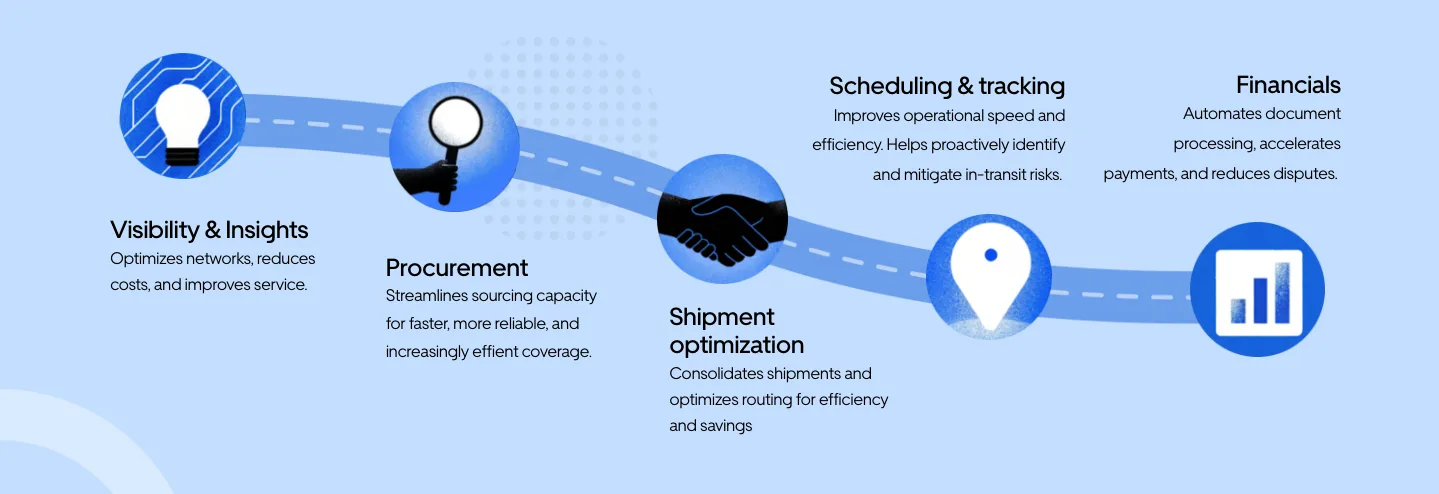
At Uber Freight, we’re already orchestrating one of the most advanced agentic AI systems in logistics, purpose-built to automate real-world tasks across the shipment lifecycle. While others are still focused on text-only tools, we’ve embedded AI agents across image, voice, and text to improve how you visualize, schedule, track, and pay for freight.
What’s to come for Uber Freight’s agentic AI innovation
Today, Uber Freight leads the industry in deploying agentic AI that takes real proactive action, pulls live logistics data from image, voice, and text sources, and automates with confidence. We’re actively building agents that can:
Solve issues before they escalate.
Make their own plans based on patterns in your network and benchmarks across our platform.
Learn from their own outputs, iterating in real time to continuously improve outcomes.
This next phase of agentic AI isn’t just about automation—it’s about autonomy. As we expand our orchestration capabilities, Uber Freight’s AI agents will shift from supporting logistics execution to truly running it—proactively, intelligently, and at scale—unleashing your team’s full potential in ways you’ve never experienced before.
Perform physical actions in the real world
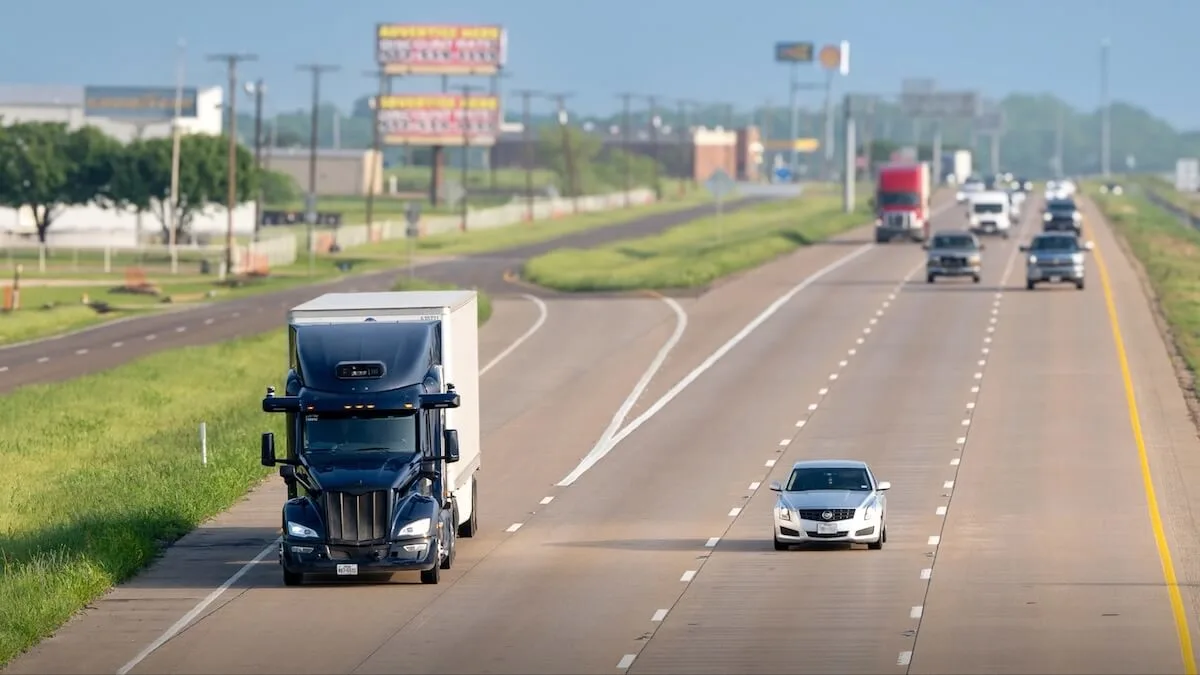
In the last six months of 2025, we didn’t just talk about the future of freight—we drove it forward. What began in 2021 as a bold vision with autonomous trucking company Aurora, became a historic reality in 2025 with freight delivered by driverless trucks on public roads.
In April, Aurora’s self-driving trucks started running round-trip hauls between Dallas and Houston, delivering live, commercial freight without a human behind the wheel. And Uber Freight hit a historic milestone, becoming the first logistics platform to offer shippers access to fully driverless Class 8 trucks operating on public roads.
Uber Freight’s autonomous vehicle (AV) carriers have achieved remarkable results to date:
500,000+
supervised autonomous miles logged on public roads over the last four years
20+
across multiple industries use AVs to move freight every day
Autonomous trucks
have delivered everyday essentials including pet food, paper products, beverages, appliances, and packaging materials. While not every commodity moves daily, a subset of these goods is delivered every day in Texas.
An end-to-end autonomous solution
For shippers, autonomous trucking ensures that the goods people rely on get to where they’re needed most more efficiently. As part of our partnership with Aurora, we’re integrating Aurora Driver into the Uber Freight platform to create a seamless end-to-end solution where booking, tracking, and load changes are managed digitally and efficiently with automation.
Faster, more predictable deliveries: Autonomous trucks don’t sleep and are not subject to Hours of Service requirements. That means they can run continuously for faster delivery times, more reliable schedules, greater control over inventory, and routes optimized for efficiency, not driver limitations.
Real-time visibility and predictive ETAs: Autonomous trucks have the most up-to-date, state-of-the-art software, providing the most predictable ETAs and real-time visibility.
Environmental impact: Cut idle time and reduce empty miles to improve efficiency and meet transportation emissions goals.
Enhanced network optimization strategy: Shippers can plan around AV lanes, from facility design to network optimization, knowing that Uber Freight is paving the way for scalable, long-haul autonomy.
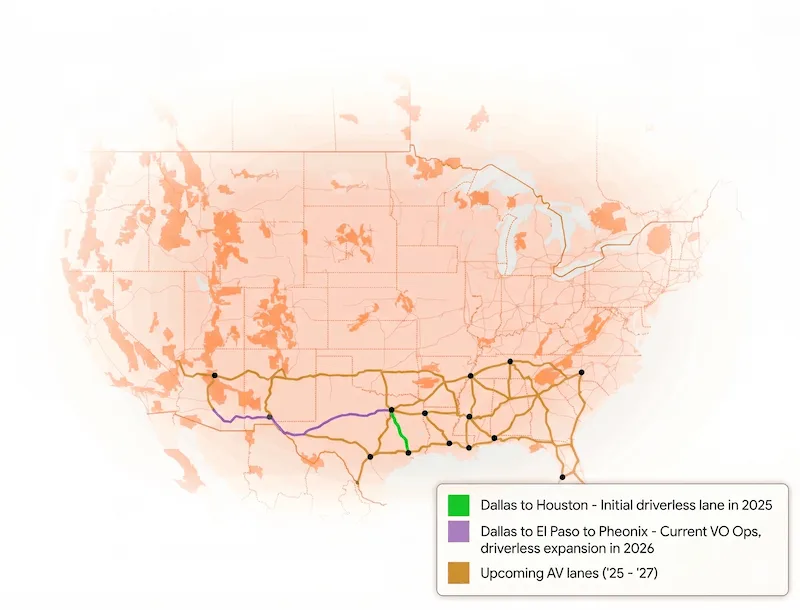
Uber Freight has opened up new opportunities for carriers:
Seamless access to autonomous freight
Through our deep integrations with AV tech providers and dedicated operations team, we provide carriers looking to incorporate AVs in their fleet a seamless transition with easy-to-use tools to quickly deploy their AV capacity on the Uber Freight network.
Priority access to autonomous trucks
We’re proud to have designed and pioneered the Premier Autonomy Program, which provides early access to more than 1 billion of Aurora’s driverless miles to Uber Freight carriers through 2030, enabling carriers of all sizes to enhance their business through autonomous technology.
Looking ahead, we’re preparing to help Aurora expand driverless operations to El Paso and Phoenix by the end of 2025, unlocking new lanes and opportunities for the industry.
Get involved in pilots: Reach out to your sales rep or av-ops@uberfreight.com to learn more.

Recommended content

Through its long-term partnership and collaboration with Uber Freight, the chemical producer has evolved from having a decentralized, manual logistics operation to a streamlined, tech-enabled supply chain.

See how a multibillion-dollar chemicals manufacturer partnered with Uber Freight to unify international forwarding and customs, shift costly air to optimized ocean, unlock real-time visibility across every mode, and save ~$145K annually while strengthening compliance and agility.

By combining advanced technologies, real-time visibility, and a reliable carrier network tailored specifically to the complexities of chemical logistics, shippers can optimize and achieve the supply chain KPIs that matter most.